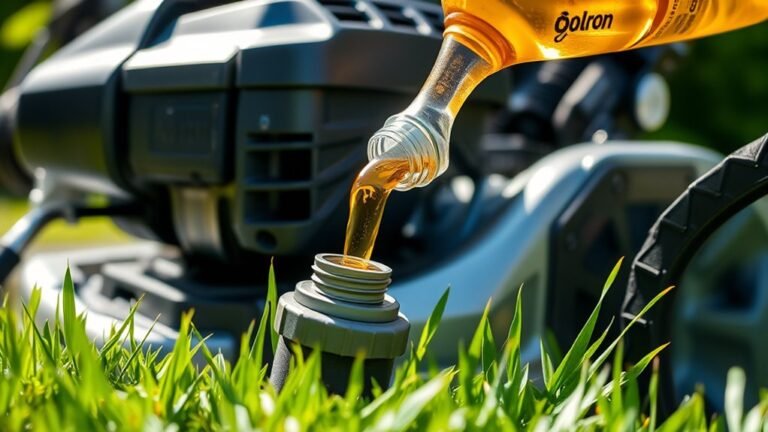

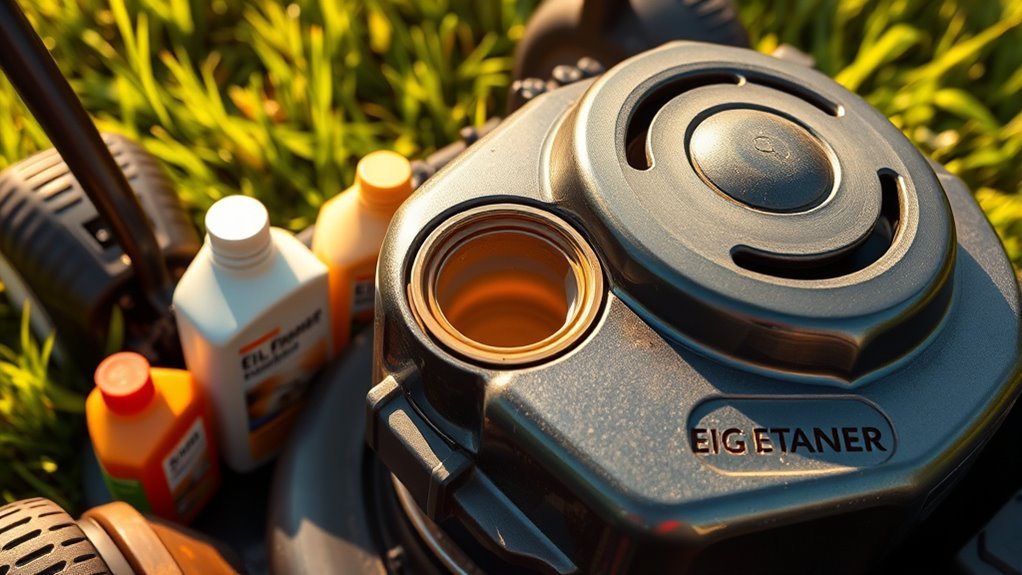
What Type of Oil Does a Lawn Mower Take?
You should use high-quality, detergent oils like SAE 30 if you mow when it’s consistently above 40°F.
Or, go with SAE 10W-30 if temperatures fluctuate between 0°F and 100°F.
Synthetic oils such as 5W-30 offer excellent protection across all climates.
Always check your mower’s manual for the exact oil type and capacity to avoid overfilling.
Keeping your oil clean and changed regularly helps your engine run smoothly and last longer.
There’s more to know about maintaining your mower’s performance.
Types of Oil Suitable for Lawn Mower Engines
When choosing oil for your lawn mower engine, it’s important to pick the right type based on the temperature you’ll be working in. Lawn mower oil comes in various engine oil types, each suited for specific temperature ranges.
SAE 30 oil is ideal for warm weather above 40°F. It offers consistent oil viscosity for effective lubrication, which helps your engine run smoothly.
If you work in fluctuating temperatures, SAE 10W-30 is a versatile choice. It covers a range from 0°F to 100°F, so it adapts well to changing conditions.
For superior protection, synthetic oil like 5W-30 performs well across all temperatures. Plus, it can enhance your engine’s longevity, which is always a bonus.
Always follow oil recommendations and use high-quality detergent oils classified SF or higher. This keeps your engine clean and running smoothly.
Choosing the proper oil capacity also matters, so make sure to consult your mower’s manual for details. That way, you get the best performance out of your machine.
Recommendations for Oil Quantity and Maintenance
Although oil quantity varies by model, you should always check your lawn mower’s manual to know the exact capacity before adding oil. Most models hold between 15oz and 64oz, so knowing the correct oil capacity is essential.
Check your lawn mower’s manual for exact oil capacity—most hold 15oz to 64oz.
Always use the recommended oil type and viscosity—such as SAE 30 or 10W-30—to guarantee proper lubrication. For better engine performance, consider synthetic oil if specified.
Regular maintenance means checking the oil level with the dipstick, keeping it between the full and add marks. Perform an oil change every 50 hours of operation or annually, whichever comes first.
Remember to let the engine cool before maintenance, clean the dipstick, and add oil gradually to avoid overfilling. Following these steps will keep your lawn mower running smoothly and extend its lifespan.
Conclusion
Choosing the right oil for your lawn mower isn’t just important—it’s absolutely life-or-death for your engine! Using the wrong type could turn your mower into a smoking, sputtering mess faster than you can say “mulch.”
Stick to the recommended oil types and keep an eye on the quantity to make sure your mower runs smoother than a freshly waxed surfboard. Trust me, your grass—and your sanity—will thank you!
When it comes to lawn mower oil, always check the manufacturer’s guidelines. Most mowers use SAE 30 oil for warm weather or 10W-30 for colder climates. Using the correct oil type ensures optimal engine performance and longevity.
Don’t forget, regular oil changes and the right oil type keep your mower running efficiently. So, choosing the right oil isn’t just about maintenance—it’s about protecting your investment and keeping your lawn looking great all season long.