
10 Steps to Operate a Zero Turn Mower Safely
To operate a zero turn mower safely, start by preparing your mower thoroughly. Check all parts carefully and make sure the batteries are fully charged. Wearing the right gear is crucial—put on sturdy shoes, gloves, and eye protection to keep yourself safe.
Next, clear the mowing area of any hazards like rocks or sticks. Inspect and secure the blades and controls before you even think about starting the engine. It’s a good idea to practice basic maneuvers such as turning and reversing in an open space to get comfortable.
Always maintain a safe speed when mowing, especially on slopes. Avoid steep inclines to prevent accidents.
After you finish mowing, don’t forget to clean the mower and store it properly. Following these steps gives you a solid foundation for safe and effective mowing every time.
Prepare Your Zero Turn Mower for Operation
Before you start mowing, make sure your zero turn mower is fully assembled with all parts securely in place. Check the manual or instructional video to confirm everything is installed correctly.
Next, ensure the batteries are properly loaded and charged using the dual-port chargers. This guarantees enough power for your mowing session.
Inspect the mower for any loose parts, damaged blades, or faulty controls. Addressing these issues beforehand keeps the mower safe and efficient.
Finally, adjust the cutting deck height on the right side to match your desired grass length. Always do this on a flat, stable surface to maintain balance and precision during mowing.
Taking these steps helps you get the most out of your zero turn mower safely and effectively.
Wear Appropriate Safety Gear
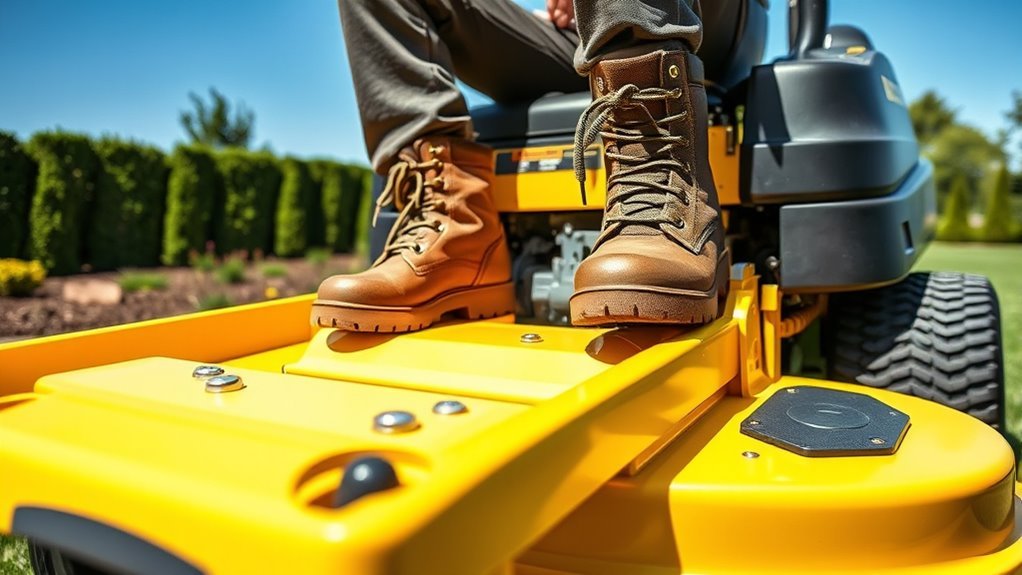
Wearing the right safety gear is essential when operating your zero turn mower to prevent injuries from debris and moving parts. Start by putting on sturdy, closed-toe shoes like work boots or sneakers to protect your feet.
Always wear safety goggles or glasses to shield your eyes from flying grass, rocks, and debris. Long pants and gloves are a must to prevent cuts, scrapes, and contact with sharp blades.
Avoid loose clothing or jewelry that could get caught in the mower’s moving parts or controls. And if you plan to mow for extended periods, consider using hearing protection to guard against loud noise.
Inspect the Mowing Area for Hazards
While preparing to operate your zero turn mower, take the time to thoroughly inspect the mowing area for any hazards. Walk around to spot rocks, toys, branches, or hidden dangers like uneven ground.
Remove or mark these hazards to avoid damage or accidents. Be mindful of nearby water bodies and steep slopes, as your mower can be unstable there.
Clear debris and loose objects that could be thrown by the blades, and ensure children, pets, and bystanders stay clear.
| Hazard Type | Action Needed | Reason |
|---|---|---|
| Rocks & Branches | Eliminate or mark | Prevent mower damage |
| Uneven Ground | Mark or avoid | Avoid tipping or accidents |
| Debris & Objects | Clear | Prevent flying projectiles |
| Water & Slopes | Stay clear | Ensure mower stability |
Check and Secure All Mower Components
Although you may feel enthusiastic to start mowing, take a moment to check and secure all mower components to guarantee safe operation. Before using your zero-turn lawn mower, inspect batteries, the seat, steering levers, and blades to confirm they’re properly installed and tight.
Before mowing, always check batteries, seat, steering levers, and blades to ensure safe and secure operation.
Use your assembly manual or unboxing video as a guide to spot any loose or missing parts. Make sure safety features like blade covers and safety switches are in place and working correctly.
Verify that batteries are securely seated in their compartments. Use the provided wrenches to tighten all fasteners, ensuring the mower is structurally sound.
Taking these steps helps you enjoy safe mowing and maintain control, especially when making turns with your zero-turn lawn mower. It’s worth the few extra minutes to be sure everything’s set up right!
Start the Mower Correctly
Before you start the mower, make sure all controls are set correctly and safety features are engaged. Double-check that the PTO switch is off and the steering levers are in neutral with the parking brake on.
Also, check the engine’s condition. Use the choke only if the engine is cold to help ensure a smooth start.
Prepare Controls Properly
To start your zero turn mower safely, make sure the ignition switch is set to “on” and the PTO switch is off. Check that the steering levers are in the neutral (park) position and the parking brake is engaged.
Insert the key and turn it slowly to the “start” position, holding it for up to 10 seconds. Once the engine starts, release the key and turn off the choke to avoid flooding.
| Step | Action |
|---|---|
| 1 | Set ignition switch to “on” |
| 2 | Turn PTO switch off |
| 3 | Put steering levers in neutral |
| 4 | Engage parking brake |
| 5 | Start engine and release key |
Ensure Safety Settings
Once you’ve properly prepared the controls and engaged the parking brake, you need to confirm that all safety features are active before starting the mower. Follow these steps to ensure safety settings are correct:
- Verify the steering levers are in neutral and the PTO switch is off. Double-check that the blades are disengaged and safety interlock systems are functioning properly.
- Insert the key and turn it to the “on” position, holding for up to 10 seconds to start the engine. If the engine doesn’t start immediately, don’t worry—wait 60 seconds before trying again.
Verify Engine Conditions
Although you’ve confirmed all safety settings, you’ll want to make sure the PTO switch remains off before starting the engine to avoid accidental blade engagement.
Insert the key into the ignition and turn it to “on,” listening for engine startup cues. If the engine is cold, pull the choke fully out; skip this if it’s warm.
Set the throttle low at first, then increase once the engine runs smoothly. Hold the key in start for up to 10 seconds; if it doesn’t start, wait 60 seconds before retrying.
| Feeling | Action Needed |
|---|---|
| Cautious | PTO switch off |
| Patient | Wait between attempts |
| Confident | Gradual throttle increase |
Learn to Use the Steering Levers
When you learn to use the steering levers, you’ll gain precise control over your zero turn mower’s movements. These levers independently manage each wheel, allowing you to maneuver with ease.
Start with these key actions:
- Push both steering levers forward evenly to move straight ahead.
- Pull both levers back simultaneously to reverse smoothly.
- Push the left lever forward and the right lever back to turn right; reverse for left turns.
- Adjust one lever more than the other for tight turns or to navigate obstacles.
Use gentle, controlled movements with the steering levers to maintain balance and avoid sudden shifts.
Mastering these controls ensures you operate your mower safely and efficiently, giving you confidence on any terrain.
Practice Basic Maneuvers in an Open Space
Before you tackle complex mowing tasks, practice basic maneuvers in an open, flat area free of obstacles to build your confidence and control. Start by pushing both steering levers forward to move straight ahead, then gently pull them back to reverse.
Practice turning by pushing the left lever forward while pulling the right lever back to turn right, and do the opposite for left turns. Use slow, controlled movements to master tight corners and sharp turns, adjusting your speed as needed.
Take time to familiarize yourself with the zero-turn radius by practicing slow, deliberate maneuvers. Regular practice in this safe environment helps improve your precision and handling, ensuring you’re ready for more challenging mowing situations.
Maintain a Safe Speed While Mowing
Since maintaining a safe speed directly impacts both your control and the quality of your cut, you should keep your mower steady around 5 miles per hour. When riding your zero turn mower on your lawn, controlling speed helps prevent blade overload and keeps your turns smooth.
Here’s how to maintain a safe speed while mowing:
- Avoid full throttle; gradually increase speed when starting or changing terrain.
- Adjust speed based on ground conditions, slowing down on uneven patches.
- Use smooth, controlled steering lever movements to keep a consistent pace.
- Regularly check your speed and reduce it near obstacles or tricky lawn sections.
Handle Slopes and Inclines With Caution
Although slopes can make mowing more challenging, you need to reduce your speed and handle your zero-turn mower carefully to maintain control and prevent tipping. Always avoid slopes steeper than 15 degrees or follow your manufacturer’s guidelines to operate safely.
Reduce speed and follow guidelines to safely mow slopes under 15 degrees with your zero-turn mower.
Use the steering levers to control each wheel independently, giving you precise maneuverability on inclines. Mow across the slope instead of going straight up or down to reduce rollover risks.
Stay alert to changing terrain conditions and avoid sudden turns or full throttle on hills, as these actions can cause loss of control. By respecting the slope’s challenges and adjusting your technique, you can operate zero-turn mowers safely and efficiently.
This way, you’ll ensure a smooth and secure mowing experience on varied terrain.
Perform Post-Mowing Maintenance and Cleaning
Once you finish mowing, make sure to clean the blades carefully to keep them sharp and effective. It really helps your mower work better next time.
Don’t forget to check the battery and follow proper care tips to extend its life. Taking care of the battery means you won’t have to replace it too soon.
Finally, prepare your mower for storage by cleaning it thoroughly. Then, stow it in a dry, sheltered spot to keep it in good shape.
Blade Cleaning Techniques
Before you start cleaning the blades, make sure to disconnect the battery or turn off the mower. This helps avoid any accidental engagement, which is super important for your safety.
Proper blade cleaning techniques are key to keeping your mower efficient and safe. Here’s what you need to do:
- Use a brush or compressed air to clear grass clippings, dirt, and debris from the blades and surrounding area.
- Take a close look at each blade to check for any damage or dullness.
- Sharpen or replace blades as needed. Keeping them sharp is the best way to make sure your mower cuts effectively.
- Try not to use water directly on the blades or under the mower. Instead, wipe them clean with a dry cloth or brush. This helps prevent rust and avoids electrical problems.
Also, don’t forget to regularly check the blade mounting hardware. You want to make sure everything stays secure and properly aligned while you’re mowing.
Battery Care Tips
Because proper battery care extends your mower’s lifespan, you should always remove and store batteries correctly after mowing. Start by fully charging your batteries with a dual-port charger before storing them for longer periods. This helps maintain excellent performance and readiness.
Next, clean the battery terminals and contacts using a dry cloth to eliminate dirt or corrosion that could hinder power transfer. Store your batteries in a cool, dry place, away from direct sunlight and extreme temperatures to prevent damage.
Regularly inspect your batteries for swelling, leaks, or other signs of damage, and replace any faulty units immediately. By following these battery care tips, you’ll ensure your zero turn mower starts smoothly and operates efficiently every time you need it.
Storage Preparation Steps
Although you’ve just finished mowing, taking the time to prepare your zero turn mower for storage is essential to keep it in top shape. Proper maintenance and cleaning not only extend the mower’s lifespan but also ensure safety during storage.
Follow these steps:
- Turn off the mower, remove the key, and engage the parking brake for safety before starting any cleaning.
- Use a brush or compressed air to clear grass clippings, dirt, and debris from the deck, blades, and undercarriage.
- Inspect blades for wear or damage; sharpen or replace them as needed to maintain cutting efficiency.
- Wipe down the mower’s exterior with a damp cloth, avoiding electrical parts to prevent rust and corrosion.
Finally, store your mower in a dry, sheltered location to protect it from weather and preserve its performance. It really helps keep your mower ready for the next time you need it.
Conclusion
So, you’ve geared up, checked every bolt, and mastered those tricky turns—only to realize the biggest hazard might be your own overconfidence.
Operating a zero turn mower safely isn’t just about speed or skill; it’s about respect for the machine and the ground beneath you. Remember, rushing through can turn your neat lawn into a chaotic jungle faster than you can say “zero turn.”
Stay sharp, stay safe, and keep those blades—and your wits—spinning smoothly. Always follow safety tips, maintain proper control, and be aware of your surroundings to ensure smooth operation.
By respecting the mower and ground, you’ll enjoy a safe, efficient mowing experience every time.